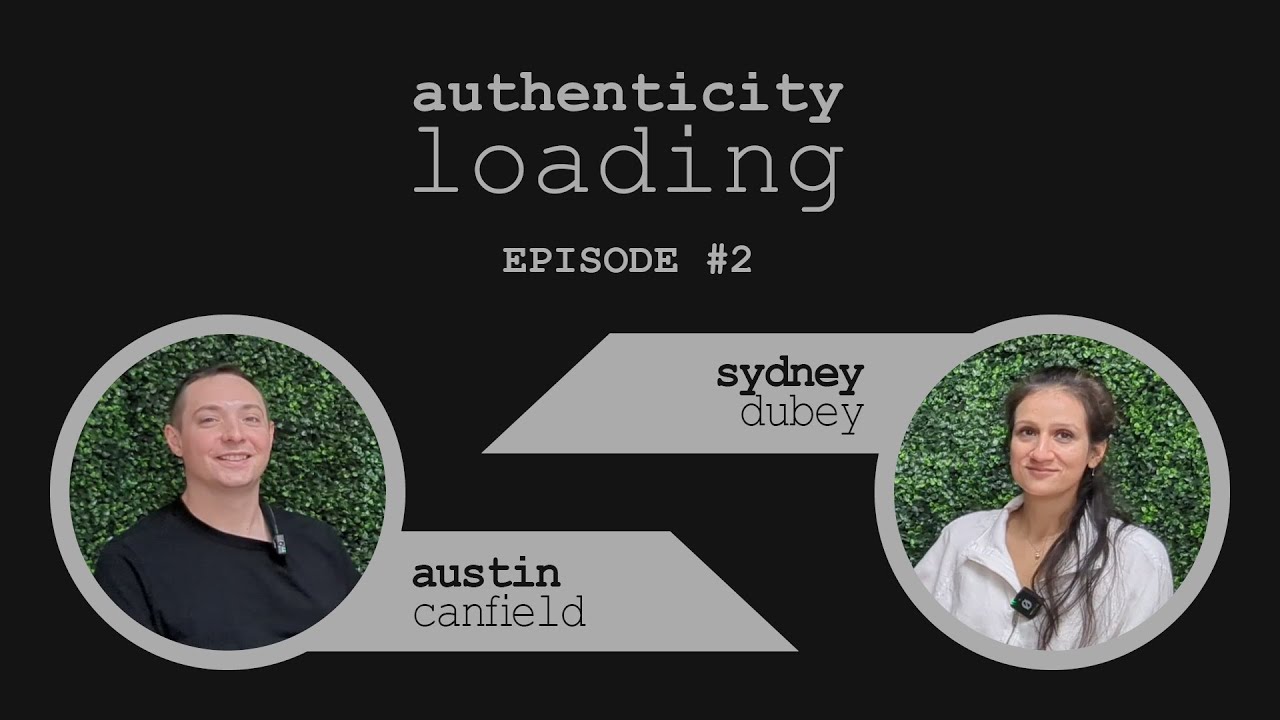
Episode #2 - Sydney Dubey
Description
In this episode of Authenticity Loading, host Austin Canfield sits down with Sydney Dubey (also known as Coach Sydd) for a wide-ranging conversation about place, purpose, and personal evolution. From Houston to the Bay Area, and now Sacramento and Placerville, Sydney reflects on how Northern California’s diversity of landscapes, pace of life, and community energy helped her slow down, recalibrate and ultimately pivot from a career in oil and gas project management into full-time coaching. The discussion explores what it means to feel at home, how geography can shape identity, and why Northern California feels like the whole world in miniature.
The conversation also dives into Sydney’s work as a superhuman performance coach, blending health, wealth, mindset, and lifestyle design into a holistic framework for ambitious early and mid-career professionals. Sydney shares how her passion for wellness began early in life, how nature plays a critical role in her personal reset rituals, and why Sacramento’s farm-to-table culture, outdoor access, and creative momentum make it a uniquely powerful place for growth. Together, Austin and Sydney reflect on authenticity, community, and the subtle ways the places we live help us become who we are.
Follow Sydney (Coach Sydd)
Instagram @coach.syddYouTube @CoachSydd
TikTok @coach.sydd
Transcript
Austin: Hey everyone, welcome to Authenticity Loading. This is your host Austin Canfield. We're a new podcast that's all about original stories from Northern California and beyond. I'm here today with Sydney Dubey. Thank you so much for joining us and being a guest on the show. How are you doing today?
Sydney: Very good. How are you?
Austin: I'm doing well, thanks.
Sydney: Thanks for having me here.
Austin: Yes, absolutely!
Sydney: Authenticity Loading. That's such a unique name. So creative and spot on. How did you come up with it?
Austin: Well, I love the idea that because of all the AI and everything that's taking over, that it's really important for humans to show their authentic self. And I think it's important to not only do that for yourself and establishing your own personal brand, but also extending that out to the community and finding other people who have authentic voices and stories to tell as well.
Sydney: Absolutely. This is great. Thanks again.
Austin: Thank you for joining us. I'm really excited for this. So, something I want to open with on the show is to ask what your favorite thing is about Northern California. For you, what would that be?
Sydney: My god, there's so many things. Um, but if I have to say one thing, I think Northern California has something for everyone. No matter what you're into, running, hiking, skiing in snow, or you're a beach person or that urban brat, it like it's got everything, right? You can wake up in Tahoe surrounded by those beautiful snow-covered mountains and that beautiful lake view and then head over to lunch to the wine country and dine at one of their Michelin star rated restaurants. Then drive over to the Bay Area, enjoy the sunset views from one of their rooftop restaurants and when the city lights come alive. And if you want to slow down, you can head to the Carmel by the Seaand wake up to the views of a beach the next day. I want to do that one day. That's, you know, that's honestly all in one weekend, by the way. All in one weekend.
Austin: Right. That's what I love about California, especially Northern California, is that like you said, there's so much diversity of choice and what you can do in your activities and how you spend your time and all the different landscapes and geography. It's just like the whole world in miniature almost. You can have so many different geographies.
Sydney: Yeah. You could be a beach person and a snow person and a mountain person. Everything. That's true. All you need is a car.
Austin: I'm curious, what's the first place that you found out about in Northern California, you were like, "Wow, this is the place to be."
Sydney: I think I think the Bay Area is where um when I was visiting my kids. I was in LA last year and I was visiting my kids. I took a stop in the Bay Area. I think it was can't remember if it was Palo Alto or some other place but around that area and I was like my goodness this feels so much like me. I've lived in Texas for the most part of my life. but nothing felt like the northern California. And that's when I was like okay this is eventually I'm going to move here. And when I came to Sacramento I was just it's a whole another town with a totally different character.
Austin: Very much. Yeah. So Texas. How did you wind up in California from there?
Sydney: Well, um, home is where heart is and my kids are here. So, that's how I ended up here and Sacramento is home for now.
Austin: Where in Texas were you based?
Sydney: Houston.
Austin: Oh, Houston. Tell me about that. What are some of your favorite things around that area?
Sydney: Well, um, Houston is it's not a town where people go. It's it's different from, so, Austin, right? Austin is the town in Texas that comes closer to California, that California vibe. But outside of that, u there's Dallas, which is a bigger metro, but there's no beach, there's no coastline. Houston has a coastline. And couple of things that, you know, when people hear Houston, they're like, "Oh, NASA." NASA's not very active there, but still there's a big presence. the medical system is very strong and popular there and it's really well known. It's like the hub for oil and gas. But outside of that, the thing that I miss the most about Houston is the food scene. You can go out, eat out in Houston. Two people go eat out at a decent place. Not fine dining, I'd say, but pretty like decent mid to upscale and healthy with tip. It'll cost you around $40 to $45.
Austin: Oh, wow.
Sydney: Yeah.
Austin: That's so unheard of in California.
Sydney: Yeah. And the variety and access to different options. mom and pop kind of places and restaurants. It's just unimaginable. You've got to go to Houston just for that.
Austin: Yeah. I remember I went to Texas one time. It was Austin. It wasn't Houston, but they had the kalachis. I don't know if they do that in Houston, but it's like the Czech pastries that I want to go back just for that. They don't have anything like that here.
Sydney: They like a lot of offices, they bring kalachis for breakfast on Fridays, like every Friday.
Austin: Oh, wow. That's interesting. Um, so you wouldn't necessarily consider Sacramento your hometown, but what part of town would you consider home these days?
Sydney: Well, Sacramento is home. There's no other place where I can relate and call home. If I can't call this home, this is where life is. And hopefully it'll continue to be. But I'm currently in Placerville. It's a beautiful out in the country neighborhood where I wake up to sun shining through tall trees and the views of turkeys roaming around, hummingbirds, deer. It's not possible. It's more like paradise. So therapeutic. So yeah, that's where I am.
Austin: Do you enjoy the Apple Hill and all of the orchards up there?
Sydney: I haven't been to Apple Hill yet. I've heard a lot about it. I just found out about it. This was my first Thanksgiving season here when I learned, oh, you've got to go to Apple Hill. But then I also heard about the traffic and I was like, okay, I'm gonna try it one of the days when there's no traffic.
Austin: Yes, you have to go very early. I would say the most popular one up there, it's called High Hill Ranch. And they do all of these different like they have a big food area where you can get their famous apple donuts and buy all of the, you know, pantry sundries like jams and preserved vegetables and things like that. But then they also have a huge arts and crafts area where vendors come out from, I guess, all over Northern California and they set up and you can go in all these little mini Christmas shops and it's just a great place. But yeah, you have to go so early and the traffic backs up right away and you just you have to be one of the first or if you're not, you'll never get in.
Sydney: So early in the day, you mean before the traffic starts building up or early in the year?
Austin: Early in the day. Yeah, I think it starts right around Thanksgiving. Maybe Black Friday is the first real like weekend where everybody's out there and all the vendors and everything. That's what we did last year for Black Friday actually. Instead of going to the mall, we went up to High Hill Ranch and Apple Hill and got our like apple butter and all the things that we get for the holiday gifts up there. And yeah, I was excited to see it though, just to see everybody coming out and supporting a local business instead of, you know, just going to the mall or the Roseville Galleria.
Sydney: And it's such a good way to, you know, spend time with the family as well, rather than being distracted at the mall.
Austin: Yeah. My whole family loves it. They talk about it all year like, "Oh, we can't wait to go and get donuts." And traditionally, my family also they go up to Placerville to get their Christmas tree. So on Black Friday, sometimes it'll even have snow on the ground already. We went up there one year and it was like, "Wow, it's already a winter wonderland and it's still November." It's amazing the climate difference between Sacramento and Placerville where you'll have snow on the ground.
Sydney: I look forward to that! I always wanted to see snow like not just, you know, see snow from a distance, but actually be in snow. So, I'm excited.
Austin: Oh, wow. So, it hasn't snowed yet up there?
Sydney: No, not yet.
Austin: Oh, well, look forward to it. It'll come, for sure.
Sydney: Awesome. Thanks for sharing.
Austin: So, how do you feel like living in this area has kind of shaped who you are as a person?
Sydney: Well, uh, so Sacramento in general has, I'd say, allowed me to kind of slow down in life and reflect and make an intentional pivot in career from being in oil and gas project management to being a full-time coach. This is where I became Coach Sydd and now I'm able to give back to the community and I love inspiring people, transforming lives and what I call building one superhuman at a time. It's almost funny because when I look back all I remember from my previous life was 50 to 60 hours in business suits and cold meeting rooms and I loved that too. I enjoyed that energy just just like constant work work. But yeah, so now being here doing this, I kind of look back and laugh at myself. But again, like I say, if you can't look back and laugh at your younger self, you haven't grown much. So Sacramento has certainly allowed that growth within me and shaped a lot of who I am sitting here in front of you today.
Austin: Yeah, I have to say being local to Sacramento now for I guess this is my eighth year here and it's so much more of a creative energy and vibe in this area than I ever thought it would be. I originally thought I wanted to live maybe in the Pacific Northwest or in Portland and I went there for a while and tried it out. But I have so much family here like like you said, home is where it is, right? And and I just ended up down here and I thought, you know, this might be temporary. I don't know. But I ended up loving it and I've been here eight years later and it's still great and creative is, you know, happening and it's a wonderful place to be, honestly.
Sydney: Definitely.
Austin: So, when someone asks the day in the life of a superhuman coach, what are some of the things that come to mind or that you tell them first?
Sydney: Well, I work with ambitious individuals generally like 25 to 45 age range who are early to mid-career. And these are men and women who have no time for fluff, no tolerance for nonsense, and there's so much information out there that's not vetted properly. And it's so it's like you would think that since there's so much information, it's so much easier, right? But it's all the more even more confusing than you know if you just read it in textbook and you decide to go one direction and everyone's you know just giving out information without actually guiding people through that change is the process of holding hands is what I do in terms of health and in terms of wealth I, so my overall goal is to make sure I unlock their so I make them feel and perform at their peak anytime every time they can tap into that superhuman and not just mentally and cognitively but also in terms of fitness and health and their entire brand. So in terms of wealth, I help them. People who are wondering, okay, now they have they've hit their first 100K in the bank accounts. How to go from 100K to a million in less than five years. I'm that friend who they need on their side, a trustworthy person or mentor who not just gives advice but actually walks them through that process and holds them accountable and checks in on them and makes sure when I leave them it's a part of their lifestyle because every choice we make everything like any sort of change it's not just a step or a process unless you incorporate that in your lifestyle, it doesn't become you. And I help them create that road map. Actually, one of my clients is a 22 year old girl and she just graduated last summer and I'm helping her with creating that 5 to 10 year strategy and road map. I wish I was like her and I had invested, I had so much commitment straight out of school. I would have like two to three times more wealth than I have right now. I love working with her. So, yeah, I love to work with people and that's what I do.
Austin: What would you say are some of the biggest challenges now for new college graduates that are just entering the workforce and it being just a whole different world than it was even 10 years ago?
Sydney: Well, I am not an expert at Gen Z and Millennial and you know all those alpha gen whatever beta generations, but what I feel is, millennials had a very different view of life. We were into accumulating wealth, right? We were into, okay, I have this and I can buy that. Gen Z, like this generation is totally different. And I don't know exactly which one you fall, which category you are.
Austin: I'm a millennial.
Sydney: Okay. So, Gen Z is not about just building wealth. They're about building that freedom. You know, they don't care for how much wealth they have. They care to have a lifestyle. So, I like that. I like that. Which I feel like I'm learning from them. But at the same time their attention spans are a little bit of an issue. And I feel you think that with more advanced instruments and so much wisdom out there they would be more financially wise but that's where I feel like I come in and a lot of the health fundamentals and basics are missing. So they all love to go to the gym. Everyone's heard of keto diets, right? But nobody knows what keto diet is. People think, "Oh yeah, just like cutting out carbs and, you know, jacking up on protein is keto diet. No, keto diet is technically it was designed for bedridden patients who don't have the ability to process carbs and you know without messing up their insulin. So it actually supposed to have 75% fat, 25% protein and then rest of it less than 5% carbs. If you overdo protein, then your protein goes that gets converted to energy and your body doesn't achieve ketosis. Ketosis is when you start burning fat. So, those are the things I help them with.
Austin: What would you say some of the biggest financial mistakes are that you see young people making today?
Sydney: There's a couple of different ones. And it depends on where you are, right? A lot of people are relying blindly on their financial advisor and then just accepting like 10 to 15% return on the market. What I tell my client is you that is a great that is a good thing if you don't know what to do right and sometimes you don't have time you have little kids you have you're trying to juggle five different things in life but I would never outsource anything that I don't understand first because then I wouldn't know how to check I wouldn't know what's the right questions to ask so that's a part of my program is to make them independent in that regards and make them understand a lot of the things whether it's provide pointing them in the right directions where it's walking them through and helping them clean their lifestyles and expenses and I do what's called a karma ledger so it's like a karma check of where are you spending most of your energy resources whether it's money or time right so like younger women they spend so much on I mean, and I'm not here to judge anybody I've been there done that myself right, but as women, we spend so much in our cosmetics or our toiletry tote could have cosmetics worth over $1,000, right? So much stuff on our hair, nails, everything. But how much do we actually spend in growth, right? We go to the gym, but do we know what it takes to actually recover your body after the gym? Growth is not happening when you're working out. That's when you're wearing and tearing that muscle down. Growth is happening when you're recovering, when you're feeding the muscle.
Austin: Right. Right.
Sydney: So, I help them understand, okay, that how much are you putting into your growth, whether it's mindset, whether it's investing in a mentor, whatever that may be.
Austin: I've heard you mention a lot about health and wellness. Can you tell me a little bit more about how that interest of yours has sort of shaped who you are as a person?
Sydney: So I want to ask that question again. Ask me that question again because what I hear is you want to know where it started or how that has shaped where I'm sitting today.
Austin: I would say both, yeah. How did you come about that passion for health and wellness and how since taking it on as as a passion and a hobby has that sort of improved yourself and your life?
Sydney: Yes. It started actually very early on in age. When I was 15, I always looked up to my dad as someone who was really fit, good-looking, an excellent public speaker who was always the most well-dressed in a leadership role. And he passed away when I was 15 due to a health condition and doctors made a mistake and a bit of combination of everything. But that's when it was really early on in life when it brought my attention to that okay knock, knock this is a thing you know you can't take life for granted it's too short and how I saw the entire process unfold in front of me where there were no balances and checks in the process and that was extremely educational but at the same time nspirational as well because I wanted to make sure that that doesn't happen with my sisters, my mom, myself or my future family. So that that was really the beginning of it. And when I became a mom, I didn't like any of the products on the shelves. Like you'll go find these baby foods and creams and lotions. It's all so like all the chem, I'm a chemical engineer. So when I read the labels, I'm like, "Nope, I'm not putting that on my kid." And kids have this bad habit. My son, what my son would do is like when he was very little and my and his nanny would be massaging him with the lotion, he would just eat out of curiosity. He wanted to taste everything. You know, we've all done that. So, I started making everything like all skincare products including soaps, lotions, scrubs, masks, everything at home. Yeah, so being a mom, being a kid, like every single step in life has kind of brought me to where I am.
Austin: I'm curious on the economic side. Did you find that it was more or less economical to make all the different child care and personal care products at home?
Sydney: You know what? That's an excellent question because not many people think of it. When you think, oh, I'll just make it at home. Everyone's thinking, oh, that's cheaper, right? When you put that whole like the time you spend on it, you have to do some research. You have to do some playing around. But aside from that, even if you just are looking at the dollars, when you have to buy this much to be able to just make this much, right? And everything together, it's not as cost efficient. And I'm getting to your point here. So, it may be more expensive, but it's definitely a lot better for your skin because our skin is our largest organ. The moment you put something on it, it goes straight to your bloodstream except for a few layers that try to stop it. But yeah that's why you know the medicinal creams and ointments work that's the whole mechanism. So when you take the whole total dollar figure into consideration it's definitely more expensive but if you can either batch it or you know you can make a little bit more share it with your friends that's one thing you can do and the return on investment when you look at the future health of your family is definitely way higher than what you can get from these buying these commercialized products but they are bulk manufacturing doing it and that's why it's cheaper. So that's why when you go to a farm, another option would be to go to a farmers market and actually talk to the people who are actually making it, right? Talk to them. You can even get them to customize a product for you. If you say, "Okay, I don't like this scent. I don't like lavender. I'm allergic to it or I don't just don't like it. Can you make it in rosemary?" So that would be a little bit more cost-effective.
Austin: That's a good idea.
Sydney: Yeah. Building relationships sort of within the community and leveraging those resources too and helping the small businesses.
Austin: Yeah. When you think about the places around Northern California that make you feel the most yourself, what comes to mind?
Sydney: I feel that have you ever been to that Auburn-Cool area by the confluence of rivers?
Austin: Yeah.
Sydney: That's one thing I would say. It's what you typically like I just go there for a run. I spend two to three hours there before I head back and I can disappear there for hours and the trails are just unending. If you go to the Cool side, I typically go to stage coach because there's some construction going on at the moment. But I can disappear there for hours and it's just so it it reminds me of the Mount Wilson in Sierra Madre, LA, which is where I used to go for a run every Sunday when I was I was down there last year. And it's all I'm focused on is my breath and my next step. It's very like meditational and it's like it when I'm present in that moment my it connects me to my past it's like everything comes together all at once. It's like past present and future happening together. I feel like that's my place where I go for resetting myself. That's my reset button or restart button.
Austin: Would you say that being not necessarily one with nature but experiencing nature and being outdoors is part of a general health and wellness sort of culture?
Sydney: Well, everyone's different, but for me, yes, it is. And in general, the bio frequency of our body and heart, it has it the signature of, it matches closely to the nature than artificial buildings and monuments.
Austin: That's true. Yeah. One of my favorite stories that people tell whenever I mention like that Auburn area is how there's that big, the Forest Hill Bridge, and how it's such a tall bridge because originally they were going to build a dam there and it was going to be this huge lake and the lake never materialized. So now we just have this this huge bridge and just a river I guess flowing way underneath it.
Sydney: Yeah. But thanks for sharing that. Now I understand what's going on there.
Austin: What is it about that area, I guess, and being in nature that feels right to you?
Sydney: The fact that I can just get lost. Actually, I have gotten lost there. I usually just grab a banana and some coconut water, put it in my car. I don't like to take too much water, but there were these two times when I didn't take any technology with me, so I'm not running with my phone. And I got lost there. I didn't know what the time was, how many hours I've been there. I couldn't see any human and I couldn't ask anybody, hey, which way to go. It's just being out there in nature. Like there's river, there's mountain, there's fresh air. There's no noise. There's just birds and light and you. Yeah, just kind of being at one with yourself and just privacy, I guess, but also out in nature. And Yeah. It's great.
Austin: If you could spend an entire weekend doing the things that you love doing most, what would that weekend look like?
Sydney: Well, I would definitely start my day with a run in the Auburn area, head back home, grab some lunch, sip a nice cup of ginger tea, then head over to the spa to enjoy some steam sauna and a cold lunch. After that, maybe explore a new cuisine or restaurant in Sacramento downtown. It's a pretty unique downtown.
Austin: Definitely, yeah. Do you have any sort of records or anything as far as running goes or the longest that you've ever run? Yes. So I remember when I was in Mount Wilson, it was like a full 14 miles. So 7 miles up, 7 miles down. I never did that because I love running and I do it as a means to an end, not to like die and not, you know, not be able to perform like 10 to 11 hours at work the next day. But the longest I've run is I want to say 11 miles and there was this one time when I actually I started my hike a bit late and LA gets really hot in summers. By the time I was back, I just wasn't feeling right. And I called my friend and I was like, I don't know if this is uh, you know, food poisoning or cramps, nausea, or if it's, so he pointed out, you're dehydrated. You need to go run to the IV. So, I went and got that. But that was after that longest run was 11 miles. I think I've hit the 11 miles in Cool also once. Were you running that whole time, the whole 11 miles? Uh, so Mount Wilson, I'd say no. The Cool-Auburn area doesn't have that much slope. So, I may have been running unless there's a spot where I feel like it's really tricky to be running and it's just better to slow down. And when you're going up, you're not running that fast, right? Your strides are not very big. You're not running that fast. So, you're kind of just trying to regulate that breath and keep a sustainable breath that will help you get to the point where you can turn back around and come down.
Austin: I see, yeah. Are there any other areas beyond Auburn or Cool that you like to go and just experience nature and do some of, you know, your other favorite outdoor activities?
Sydney: I haven't explored Sacramento that much, but Auburn is definitely my most favorite one. When I have time, I typically would go to the wine country, Napa, and that's another direction I would head to, unless you have some really cool hidden treasures where I can explore.
Austin: You know, I would say just things I like to do on a short weekend trip, I like to go up to the Fair Oaks area off Highway 50. Sort of like off Sunrise Boulevard and they have a couple pedestrian bridges where you can just go out and just walk along the American River.
Sydney: I've seen those. I just never thought of stopping there. Thanks for sharing.
Austin: Yeah, it's not a super long adventure or anything, you know, maybe 30 minutes or so just to walk along the river and cross the bridge and just just look at nature. it's actually pretty developed I guess around there. So you're not really in like remote nature wilderness or anything.
Sydney: Yeah. Since you ask nature that's why it made me pause and think but if when you say that it reminds me of I think is it connected to you know like if you go to the Folsom downtown you can kind of walk by the river too.
Austin: Yeah I think that is all connected there. Sort of like the American River trail system.
Sydney: Yeah. Yeah. That's pretty neat too. Actually Folsom has its own little town vibe.
Austin: It does, yeah. I need to explore in downtown Folsom more. There's a lot of good restaurants and things there. Yeah, I think that was one of the first things I did when I first moved here. I wanted to go see the American River down there around Folsom. People said that that's where all the bars and everybody like to just hang out and you can go down there to the river under the, there's like an older bridge that crosses it alongside the newer Folsom connector bridge. And there's these rocks out there and you can just kind of sit and look at the water and see all of the kayakers and the people in the speedboats and everything and everybody's just having a good time and it's fun to just, you know, sit and people watch, I guess, along the river.
Sydney: Yeah, I like places like those because when you were asking me about Houston, one thing Houston like doesn't have that California has is you can just go out, do nothing, pay nothing, and spend time in like proximity of nature.
Austin: Have you been back to Houston since moving here?
Sydney: Yes. Yes.
Austin: When you go back, do you feel like it kind of reminds you of like I guess a past stage of your life?
Sydney: Yeah. See, it's not the things and people, it's sorry, it's not the things and places, it's the people and experience, right? So, when I go back to Houston, I'm mostly spending time with the families and friends that you know, from my past life. And it just doesn't give me enough time to go explore Houston. It was just like literally I was there for 3 days and I had to meet six friends and families and that was it. I couldn't go to one single place that I thought, "Oh, I'm going to go here."
Austin: Mhm. Yeah. It's interesting as someone who's also lived in a lot of different cities now around the US, I was originally on the East Coast and then I moved out here about eight or nine years ago and yeah, every time I go back now, like you said, it's about the people. It's like, well, I want to see, you know, my family that's over there or maybe see an old friend. We went to Washington DC this past year and I met up with some old friends from high school actually and it was just neat to catch up and you know go to the Smithsonian museums and yeah, it was just a fun time.
Sydney: Yeah, it's it's not fun without people like, it's like, yeah. So that's exactly why I call Sacramento home, right?
Austin: What are some of the things in your life that sort of influence the places you go and the activities that you do?
Sydney: I think if I have to answer that, like I said, it's not the things and places, it's the people and the experiences I crave for. So, when I meet someone, I typically ask them what they love to do and I try to see if I can find something that I would love to enjoy. And when kids push me to do something, try something, you know, they like one of the things would be always my son, K1 Speed, go mommy, and then the whole, the desire to go explore places to find new experiences and hidden treasures I can share and bring back to my kids and let them experience that too. So that's just some of the things that come to my mind when you ask that question.
Austin: How would you describe the Sacramento area as someone who's fairly new here to someone else who maybe is thinking about being here but has never been here before?
Sydney: All right. Well, for the starters, I'd say it's a very unique town with quite a lot of character and a lot of potential as well. So, it is a city, but it's not crazy expensive like the Bay Area. It's not crazy busy. So, the pace of life is manageable. You can raise a family here. The real estate is still affordable and there's a lot of it. Lot of it, right? A lot of wide roads, traffic is not such a big issue. And besides that, it's the farm-to-table capital. So, you know, you get to experience that greenery, that produce, all of that. And with all that, it's still growing. There's a lot of companies that are moving into Sacramento. So it has unlimited potential when it comes to that because of the real estate it's like a city ready to host companies and businesses and more of that ecosystem. Only thing is like it's a bit extreme when it comes to weather like summer it gets really hot, winter it gets really cold but not like four feet of snow.
Austin: Right. Right.
Sydney: I'm also asking. Right. So it's that's a plus too.
Austin: Yeah. That's true. Sure. I guess up once you get into higher elevation, it does start to snow. But yeah, down here in the valley, it rains a lot in the winter, which surprised me, which I remember visiting here when I was a kid and it was over the summer and it was just so hot and so dry and I asked, "Does it ever rain here at all?" and my other family members that have lived here their whole life, they were like, "Oh yeah, it rains all the time in the winter." And when you're only here in the summer, it's hard to even imagine. But now that I understand more how the central valley geography works and the climate system and all that, it does make more sense. But yeah, the winters here, at least like you said, it's no snow, but yeah.
Sydney: Do you like the winters here when it rains or the summer?
Austin: Um, you know, I'm honestly kind of a spring and fall kind of person. I like especially autumn. like after it's been so hot and dry for so long and then you finally get the first wave of cool weather and the leaves start to change like a little I guess like around Halloween is sort of like my favorite time of the year here.
Sydney: Gotcha.
Austin: Are there any neighborhoods that you've been able to explore in the Sacramento area where you're just like, "Oh, wow. This this area is so for me."
Sydney: Well, I've been exploring Placerville quite a bit because that's where I am right now. And I think that's a part of how I connect with where I go. I've relocated by the way seven times in the last three years.
Austin: Oh wow.
Sydney: And this is the first thing I do is I explore the place. I go to different restaurants and stores and that gives you a good flavor for what the area is like, people are like, culture is like and plus is what I've been exploring. I found some really unique things there. There's this store which is like I didn't expect it to be. Plus, when I took my daughter, she was like, "Oh my god, this is like this is like Disneyland for fashion." Like she loved a lot of stuff there. There's a store I found where they sell handmade lotion creams. Just exactly, you know, what I'm into. And the prices are just like so unbelievable and affordable as compared to if you were to purchase the same product like in the Bay Area or a metro like Houston. So that and a couple of very unique restaurants, too.
Austin: When you're thinking about, I guess, planning a trip or traveling somewhere, do you feel like you have any kind of personality traits that kind of sway your decision making toward one place or another?
Sydney: That's an interesting question. I want to say like I'm into both sometimes, but okay so, I'm not into the, I’m not the kind of person who would go out camping and just live in a very uncomfortable and I love camping as long as there's comfort. You know, and I'm not saying I'm into glamping. Not to that extreme, but I like both. I like safety and I like to be able to sleep at night without having to worry about snakes and bears outside, but at the same time being close to nature. So, I like best of both the worlds. I feel like Tahoe was such a great I remember going there last year with kids in October time frame. We rented this Airbnb which had a part view of the lake. It was so beautiful blue and we could see like shooting stars in the dark sky, sit in the balcony, enjoy a cup of coffee and then go hiking the next day. My son had to film some, you know, beach stuff with his new drone. It was beautiful. So, yeah, that's that's like I want best of both of worlds.
Austin: Yeah.
Sydney: Best of like not too rural, not too isolated, but still have the amenities and be close to a grocery store where I can go get something, too. Yeah.
Austin: Yeah. I guess I'm kind of the same way really. Like I want to experience nature and feel like I'm, you know, getting out of my comfort zone, but not too far out of the comfort zone, you know? And finally, can you think of a moment through all of your travels, throughout your life, where you went somewhere or did something and you just thought, "Wow, this this place or this thing that I'm doing is this perfect extension of myself.”
Sydney: Lately. I would say one thing that stands out is that Tower Bridge dinner. So, if you know, Sacramento City hosts this Tower Bridge dinner. It was my first time experiencing that. It was it was just like so unique, so different in the heart of the city. They closed down the bridge and everyone there is like nicely dressed, relaxed, present, just enjoying the time, wine and dine in the in the middle of the city again. So there's lights and the you know the day turns into evening to night. It was just like it felt so like me and that whole community experience. It just made me feel not just like me but also really happy to be a part of this community that cares to you know have such unique events and that really was about celebrating farm-to-table and city actually going all the way out to do and build something so special like as an experience for everyone. It was very unique.
Austin: Yeah, I've heard that that event can be kind of competitive to get tickets for that it sells out within like five minutes of of the event going live.
Sydney: Yes, I heard that. I was just lucky to you know, get it through a friend. But that's true. It was beautiful though.
Austin: I've heard so many good things about it. One of these days I'll have to get on there and see you know just planning 100% you know to get tickets is necessary. But yes.
Sydney: They had a lottery I believe. So, like some of the people I met, they got the tickets to the, you know, the entertainment.
Austin: Oh, interesting. I'll have to look more into that because, yeah, I agree. That's such a special thing to close down a bridge, the Tower Bridge downtown, and have a whole full service dinner on it.
Sydney: That's something to experience for sure. So many businesses coming together to make it so special. It's not just one appetizer. It's like a full buffet of whatever you can. And you may want to get on their email list and, you know, just email the organizer. I heard a lot of people talk about that too.
Sydney: Sounds good.
Austin: Sydney, thank you so much for joining us.
Sydney: Thank you so much for having me, Austin. This was, like, lovely. Really, really enjoyed talking to you.
Austin: I'm glad. Yeah, me as well. Thank you. If you enjoyed our episode, don't forget to like, subscribe, and enjoy Northern California!